Careers in Physics

Most physicists are employed by educational institutions, industrial
firms, government laboratories, or federally-funded research and development
centers. Vocations in physics fall into four major categories:
-
Research: Basic research has as its goal the understanding of physical
phenomena without a specific application in mind. Applied research leads
to the solution of problems of national importance or of significant commercial
value.
-
Development and Design: Work in this area utilizes both basic and
applied research to improve existing products, processes and instruments,
and to develop new ones.
-
Teaching: Many physicists are employed in academic institutions,
including instructors at the high school, community college, college, and
university levels. In the latter, research and teaching are often combined.
-
Management and Other Areas: Physicists can be found in a wide variety
of areas such as research administration, university administration, science
reporting, technical management and marketing, and in such fields as metallurgy,
electronics, food processing and packaging, health and radiation safety,
pollution control, computer technology, financial services and a broad
and continually expanding array of other possibilities.
For new graduates at the Bachelor level, there are fewer jobs in physics
than, for example, in chemistry or engineering; however, there are also
fewer applicants competing for those jobs. Graduates with training in physics
are recognized as having a breadth of knowledge and a good ability to analyze
and solve unfamiliar problems, and some industries hire physicists for
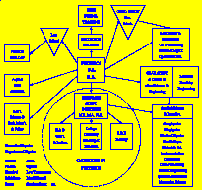
advertised engineering positions. The flowchart
illustrates some of the career paths that are open to graduates with a
Bachelors degree in physics. The homepage of the American
Institute of Physics (AIP) is a good starting point for further exploration
of career options for physicists.
Last Modified: September 12, 1995
