
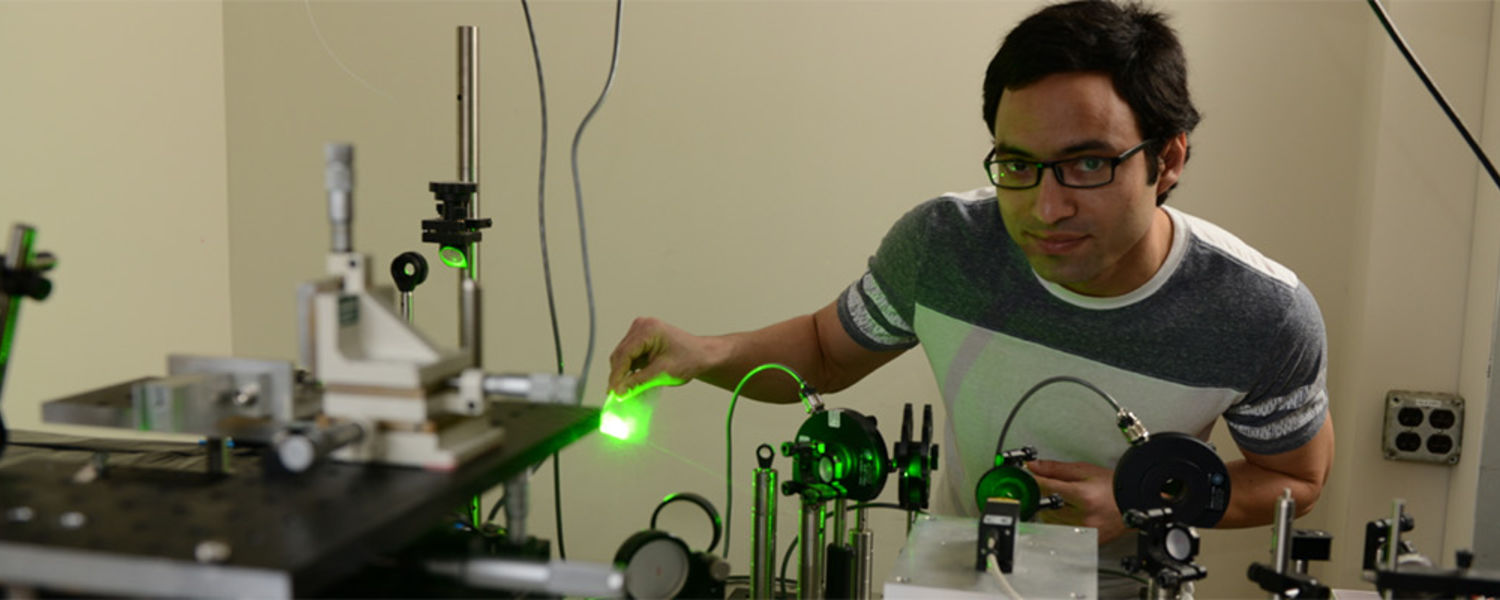
Research by Faculty & Students in our Physics Programs
The research of the Physics Department falls into four broad areas:
(1) Soft Condensed Matter Physics, especially Liquid Crystals and Complex Fluids;
(2) Correlated Electron Physics, including Superconductivity;
(3) Nuclear and Hadronic Physics; and
(4) Biophysics.
The listings below give a classification of our faculty members according to research
area, and further information on their interests can be found on their individual pages.
These classifications are largely determined by our experimental programs, and some of
our faculty have research interests that are broader than indicated.
Another way to survey our active areas of research is to consult an
alphabetical list of the physics topics and
research techniques that we study. Additional
information on our research activities can also be gleaned from our
slide show on graduate student research and
our nascent virtual tours page.
Are you are interested in graduate-level research? We invite you to consider
applying to our PhD or Master's program.
Are you currently an undergraduate at Kent? If so, please see our page on
undergraduate research.
Liquid
Crystals and Complex Fluids
Nuclear
and Hadronic Physics
Correlated
Electron Physics
Biophysics
Facilities and techniques
in experimental condensed matter physics at Kent State University include
nonlinear optics, electro-optics, tunneling and atomic force microscopy,
nuclear magnetic resonance, electron paramagnetic resonance, x-ray scattering,
light scattering, microcalorimetry, millikelvin refrigeration, SQUID
magnetometry, and magnetoresistance and Hall effect measurement. Theoretical
research in condensed matter at Kent is centered on problems in the
main two areas above, as well as independent work in computational physics,
and techniques for the quantum many-body problem.
Several of the condensed
matter faculty at Kent State University are affiliated with the Glenn
H. Brown Liquid Crystal Institute (LCI),
the only institute of its kind in the United States. The National Science
Foundation Science and Technology Center for Advanced Liquid Crystalline
Optical Materials (ALCOM)
is based at Kent State University's LCI.
The nuclear physics
faculty perform experiments or perform theoretical calculations relevant
to the experimental programs at national laboratories, especially Jefferson
Laboratory (JLab) in Virginia and
Brookhaven National Laboratory (BNL)
in New York. Some of the specific areas of interest to the nuclear physics
faculty at Kent include development of neutron detectors and polarimeters,
field-theoretical modeling of the quark-gluon structure of hadrons,
experimental and theoretical studies of relativistic nuclear collisions,
experimental and phenomenological studies of baryon resonances, and
measurements of fundamental structure functions of the neutron and proton.
The activities of the nuclear physics faculty are promoted by the Physics
Department's Center for Nuclear Research (CNR).
Interest in Physics Education
is growing significantly, and faculty involved in sponsored research in this area
include
John Barrick,
Stan Christensen,
Brett Ellman,
Tom Emmons,
Mike Lee,
Elizabeth Mann, and
John Portman.
A research niche
statement prepared by the physics faculty a few years ago provides
an overview of research efforts and planned future directions
for our research and graduate program.
Facilities
The Physics Department is located in Smith
Hall in the heart of Kent State University's Science
Complex. A Machine Shop staffed by an expert machinist is located
on the main floor of Smith Hall; a Student Shop is attached to the Main
Shop. On the third floor, there is an Electronics Shop staffed by a Departmental
Research Engineer. There is a local clean room, and many additional facilities of
relevance to experimental work in soft condensed matter physics are available in the
Liquid Crystal Institute.
The Chemistry/Physics
Library, located in adjacent Williams
Hall houses research journals, texts, and monographs.